Common Mistakes Students Make in University Assignments (USA)
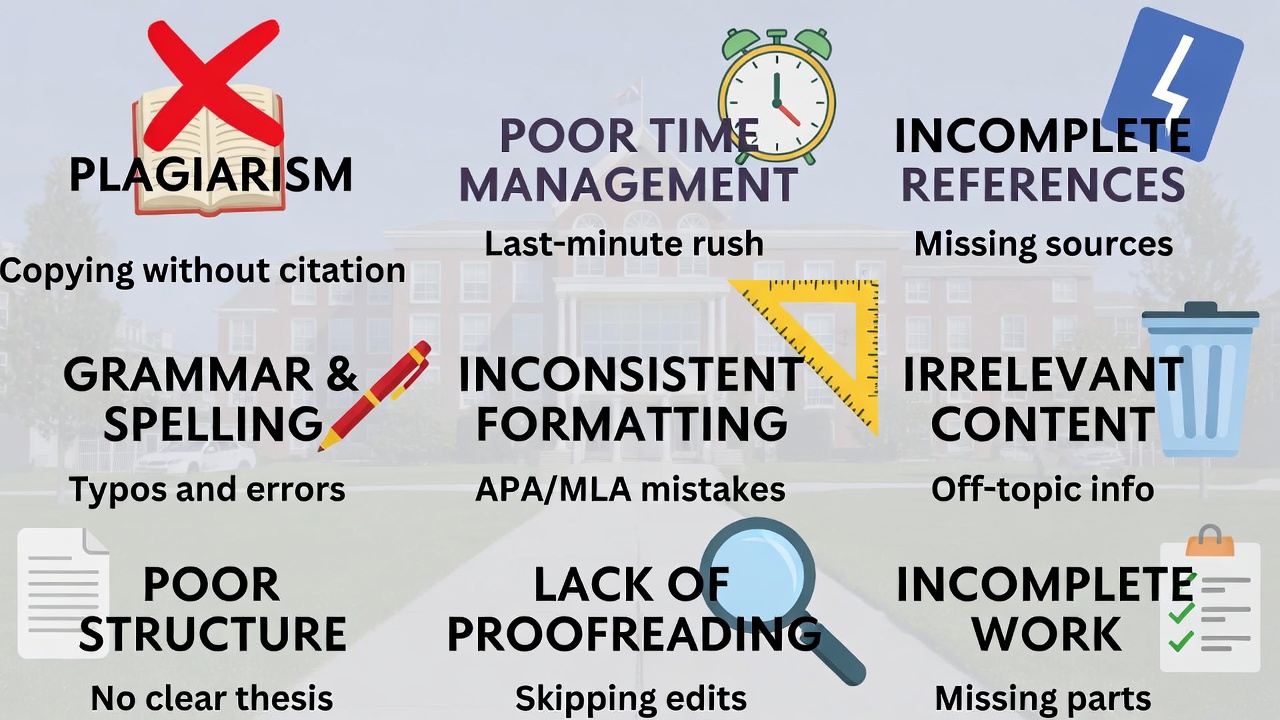
The mistakes that cost US university students the most points are predictable: not following the prompt or rubric, starting too late, a weak or missing thesis, careless proofreading, citation errors, accidental plagiarism, and submitting work that is incomplete or off-topic. Each one has a simple, repeatable fix you can build into your process.
Key takeaways
- Read the rubric before you research, and again before you submit.
- Most structure problems start with an unclear thesis.
- Citation and formatting errors are the easiest points to win back.
- A ten-minute final checklist catches most avoidable mistakes.
Why these mistakes are so common
Most students who lose points are not careless people. They are juggling classes, jobs, family and social life, and assignments get squeezed into whatever time is left. Under pressure, the brain skips the "boring" steps, like re-reading the prompt or checking citations, and those are exactly where easy points disappear.
The good news is that the same seven mistakes come up again and again. Learn to spot them and you can protect your grade without working longer hours.
Mistake 1: Not following the instructions
US professors often grade with detailed rubrics. If the prompt asks you to "evaluate" and you only "describe," you can lose a whole category of points, however good the writing is.
How to read a prompt and rubric
- Circle the action verbs: analyze, compare, evaluate, argue, discuss.
- Note the length, format, citation style, number and type of sources, and submission method.
- Check where the points are. Spend effort in proportion.
- Ask questions early, by email or in office hours, not the night before.
- Re-read the prompt after outlining to make sure you are still answering it.
The UNC Writing Center has a helpful guide to decoding assignment language if your prompts often feel vague.
Mistake 2: Starting too late
Signs you are procrastinating: "I work better under pressure," constant guilt about the assignment, and a sudden urge to clean your room. Rushed work shows in thin research, missing citations and no time to revise.
Simple fixes
- Split the task into research, outline, draft and edit, each with its own mini-deadline.
- Work in focused blocks of about 25 minutes with short breaks.
- Put your phone in another room or use an app blocker while you work.
For more ideas, see our time management tips for college students.
Mistake 3: Weak structure and no clear thesis
A thesis is the one-sentence answer to the question your assignment asks. Without one, paragraphs drift and the reader cannot tell what you are arguing.
| Part | What it should do |
|---|---|
| Introduction | Context, then a clear, arguable thesis |
| Body paragraphs | Topic sentence, evidence, your analysis, link back to the thesis |
| Conclusion | Restate the argument in new words and explain why it matters |
Weak: "Social media has good and bad effects." Stronger: "For first-year college students, heavy social media use harms sleep more than it harms grades, which suggests campuses should focus on sleep education."
Mistake 4: Grammar and proofreading errors
Small errors make a paper look rushed, and some professors deduct for them directly. The most frequent ones in American English papers are run-on sentences, comma splices, its/it’s, their/there/they’re, and inconsistent tense.
Quick proofreading routine
- Leave the paper for a few hours, then read it fresh.
- Read it aloud or use a text-to-speech tool.
- Run a grammar check last, after all content changes. Our grammar checker is free to use.
- Check names, numbers and the title one more time.
Mistake 5: Citation and referencing errors
Mixing styles, missing in-text citations, and reference entries that do not match the text are among the easiest points to lose.
| Style | Common in | In-text look |
|---|---|---|
| APA 7 | Psychology, nursing, education, business | (Author, Year) |
| MLA 9 | English and humanities | (Author Page) |
| Chicago | History, some arts | Footnotes or (Author Year) |
Build references as you research instead of at the end. Our APA formatting guide covers the most common format step by step.
Mistake 6: Accidental plagiarism
US colleges use similarity tools such as Turnitin, and instructors also notice sudden changes in writing style. Most cases start with messy notes or patchwriting, where a student swaps a few words in a source sentence.
Keep quotes and your own notes separate, paraphrase with the source closed, and cite every borrowed idea. Our guide on avoiding plagiarism walks through each habit.
Mistake 7: Incomplete or off-topic work
Running out of time leads to missing sections, and writing without an outline leads to tangents. Both cost points that the rest of the paper cannot win back.
Last-minute fixes
- Too short? Add analysis or an example to existing points instead of filler.
- Off-topic? Cut tangents and link each paragraph back to the thesis.
- Missing sections? Check the rubric and outline the gaps quickly.
- Formatting wrong? Fix the title page, margins, spacing and headings last.
Turn feedback into better grades
Graded work is the cheapest tutoring you will get. Keep a short list of the comments you see more than once, such as "unclear thesis" or "needs more analysis," and check your next draft against it. If a comment does not make sense, ask your professor to explain it with an example. Students who do this usually see the same mistakes disappear within a semester.
Frequently asked questions
What is the most common mistake in university assignments?
Not answering the exact question asked. Students write a good paper on a slightly different topic, or describe when the prompt asks them to analyze or evaluate.
How can I check if my thesis is strong?
A strong thesis is specific, arguable and answers the prompt. If nobody could reasonably disagree with it, it is probably a statement of fact, not a thesis.
Do professors really take off points for formatting?
Many do, especially when the rubric includes formatting or citation style. These are often the easiest points to secure.
How long before the deadline should I start?
For a typical research paper, start one to two weeks ahead so you have time to research, draft and revise. Shorter assignments still benefit from a day between drafting and proofreading.
Want a second pair of eyes before you submit?
Send your prompt, rubric and draft, and we will suggest how we can help.
Get assignment help