
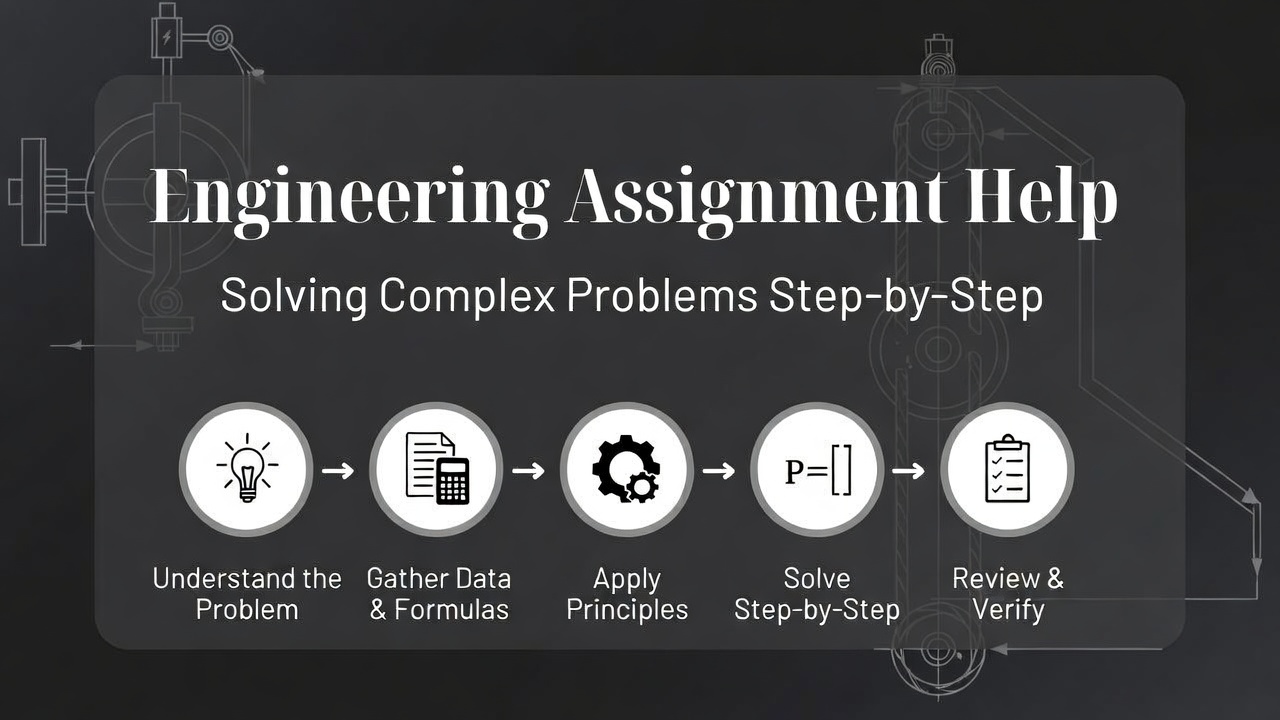
Engineering Assignment Help: Solving Complex Problems Step-by-Step
Stuck on tough engineering problems? This guide offers practical engineering assignment solutions USA with proven mechanical engineering assignment tips and step-by-step strategies used by top US college students. From breaking down requirements to validating final answers, learn how to solve complex mechanical, civil, electrical, or structural assignments efficiently. These methods help you show clear working, accurate calculations, and professional presentation—boosting grades while building real engineering skills. (118 words)
Why This Step-by-Step Guide Works for US Engineering Students
- ✔️ Clear roadmap for any complex engineering problem
- ✔️ Mechanical engineering assignment tips trusted by US students
- ✔️ Emphasis on units, diagrams, validation & presentation
- ✔️ Helps avoid common mistakes that lose marks
Why Engineering Assignments Are Challenging for US Students
Engineering assignments in US colleges demand precision, deep conceptual understanding, and rigorous calculations—often under tight deadlines. Mechanical, civil, electrical, and other disciplines require integrating theory, math, physics, and real-world constraints. Many students struggle with the volume of work and the need to show every step clearly. Mastering these challenges with proper engineering assignment solutions USA builds both grades and professional skills. (112 words)
Common Difficulties in Mechanical & Other Engineering Subjects
Mechanical engineering assignments often involve thermodynamics, fluid mechanics, dynamics, and machine design—each with multi-step problem-solving. Other fields face similar issues: circuit analysis in electrical, structural loads in civil, or control systems. Students commonly struggle with unclear problem statements, unit conversions, software usage, and interpreting physical meaning of results. These difficulties are amplified by large class sizes and limited professor availability. (118 words)
How Deadlines and Complex Calculations Impact Grades
Tight deadlines force rushed work, leading to skipped steps, calculation errors, or incomplete diagrams—common reasons for lost marks. Complex multi-part calculations (e.g., iterative solutions in heat transfer or stress analysis) require time for verification. A single mistake in early steps cascades through the solution, dropping scores significantly. Proper time management and systematic approaches are essential for high grades in US engineering courses. (122 words)
Facing tight deadlines on tough engineering problems? Reliable engineering assignment solutions USA deliver accurate, step-by-step work on time.
Step 1: Understand the Problem Statement Thoroughly
The foundation of every successful engineering solution is a crystal-clear understanding of what the problem is asking. Rushing past this step is the #1 reason for wrong answers. Take time to read multiple times and rephrase in your own words before starting calculations. This habit saves hours later. (104 words)
Break Down the Assignment Requirements & Objectives
Highlight deliverables: what must be calculated, designed, analyzed, or proven? Identify the main objective (e.g., find maximum stress, design beam for given load, optimize efficiency). List sub-questions or parts. Note any required format (report, calculations only, CAD drawing). This breakdown turns a vague problem into a clear roadmap. (112 words)
Identify Key Constraints, Assumptions & Given Data
List all given values (materials, dimensions, loads, temperatures, etc.) and units. Note constraints (safety factor, budget, size limits, environmental conditions). Clearly state assumptions (e.g., steady-state flow, frictionless surface, linear elastic material). Misidentifying these leads to invalid solutions. Write them down before proceeding. (108 words)
Quick Checklist for Reading Engineering Problems Effectively
- ✔ Read the problem at least twice
- ✔ Highlight or underline key words (find, calculate, design, determine)
- ✔ List all given data with units
- ✔ Note what is unknown (variables to solve for)
- ✔ Identify the type of problem (statics, dynamics, thermodynamics, etc.)
Still unclear on problem statements? Expert mechanical engineering assignment tips & solutions USA clarify and solve from the start.
Step 2: Gather Relevant Formulas, Theories & Data
With the problem understood, collect the tools you need: equations, principles, material properties, and standards. This step prevents backtracking and ensures accuracy. Use only reliable, up-to-date sources aligned with US engineering practices. (102 words)
Reference Standard Engineering Textbooks & Resources
Start with core textbooks used in US universities: Shigley's Mechanical Engineering Design, Beer & Johnston for Statics/Dynamics, Cengel for Thermodynamics, Hibbeler for Structural Analysis. Check university library e-resources or course syllabus for recommended editions. Cross-reference with lecture notes for professor-specific preferences. (108 words)
Use Reliable Online Tools & Calculators (USA Standards)
Supplement textbooks with trusted digital tools: Engineering Toolbox, NIST Chemistry WebBook, MatWeb for material properties, Wolfram Alpha for symbolic calculations. Use ASCE, ASME, or IEEE standards databases when applicable. Avoid random online calculators unless verified against textbooks. (104 words)
Mechanical Engineering Assignment Tips – Best Free Resources 2026
Extensive calculators, material data, unit converters—ideal for quick lookups.
Free material property database—search by name, category, or standard.
Thermodynamic properties of fluids—essential for heat transfer & fluids problems.
Need curated formulas & data for your specific assignment? Professional engineering assignment help USA provides accurate resources & solutions.
Step 3: Draw Diagrams, Free-Body Diagrams & Sketches
Visualization is critical in engineering. A well-drawn diagram clarifies relationships, forces, and geometry before calculations begin. Poor or missing diagrams are a frequent reason for lost marks—even if math is correct. Invest time here for accuracy and presentation quality. (102 words)
Importance of Visualization in Solving Engineering Problems
Diagrams help spot mistakes early, communicate your approach to graders, and apply theory visually. Free-body diagrams isolate forces/moments; flow charts show processes; sketches define geometry. In mechanical engineering, they are essential for statics, dynamics, strength of materials, and machine design problems. (108 words)
Labeling Forces, Dimensions & Variables Correctly
Label every force (F, P, W), moment (M), dimension (L, d), and variable consistently. Use arrows for direction, indicate positive directions, and include units. Use standard notation (e.g., σ for stress, ε for strain). Clear labeling prevents confusion and shows professionalism. (104 words)
Tips for Clean, Professional Diagrams in Assignments
- ✔ Use ruler/straight lines or digital tools (AutoCAD, SolidWorks, Draw.io, Visio)
- ✔ Keep diagrams large enough (half-page or full-page if complex)
- ✔ Add figure/table number and title (e.g., Figure 1: Free-Body Diagram of Beam)
- ✔ Use consistent scale and legend for symbols
- ✔ Include coordinate system or reference axes
Need professional diagrams and solved problems? Trusted mechanical engineering assignment help USA includes clean visuals & step-by-step explanations.
Step 4: Apply Step-by-Step Calculations & Analysis
This is the core execution phase. Perform calculations methodically, showing every logical step. In US engineering courses, graders award partial credit for correct methodology—even if the final number is wrong. Focus on clarity, accuracy, and traceability. (102 words)
Organize Your Work – Units, Significant Figures & Conversions
Always write units next to every value and carry them through calculations. Use consistent US customary or SI units as specified (convert if mixed). Apply significant figures rules from the start (e.g., least precise input determines output). Track conversions explicitly (e.g., 1 ft = 0.3048 m). This prevents unit errors—one of the most common grade killers in engineering assignments. (118 words)
Show All Working Steps (Even Intermediate Calculations)
Never skip intermediate steps—write each equation, substitution, and result. Number steps (1, 2, 3…) for easy grading reference. Include brief notes (e.g., “Using Euler’s buckling formula”). This transparency earns partial credit and helps you spot mistakes early. (104 words)
Use Dimensional Analysis & Error Checking Techniques
Check units on both sides of every equation before plugging numbers—dimensional homogeneity catches errors fast. Use order-of-magnitude estimates (e.g., “answer should be around 10^3 N”) for sanity checks. Double-check arithmetic with calculator memory or spreadsheet. Re-read the problem to confirm you're answering what's asked. (112 words)
Complex calculations slowing you down? Get precise engineering assignment solutions USA with full working shown.
Step 5: Interpret Results & Validate Your Solution
Numbers alone aren't enough—explain what they mean and confirm they're reasonable. This critical thinking step separates good assignments from excellent ones in US engineering courses. Validation shows understanding beyond plug-and-chug. (102 words)
Check if Answers Make Physical Sense (Reasonableness)
Ask: Does the magnitude feel right? (e.g., a 100 kg beam shouldn't deflect 10 meters under normal load.) Is direction logical? Does it align with real-world intuition (e.g., heat flow from hot to cold)? If not, revisit assumptions or calculations. (108 words)
Compare with Expected Values or Theoretical Limits
Cross-check against known benchmarks (e.g., yield strength of steel ~250–500 MPa). Compare with hand calculations or simplified models. Use boundary conditions (e.g., zero deflection at fixed end). Discrepancies? Explain or correct. (104 words)
Discuss Limitations & Possible Sources of Error
Acknowledge simplifications (e.g., neglected friction, ideal material behavior) and potential error sources (measurement uncertainty, rounding, model assumptions). Suggest how they affect results and ways to reduce them. This demonstrates maturity and critical thinking. (108 words)
Unsure if your results are valid? Professional mechanical engineering assignment help USA includes validation & error analysis.
Step 6: Write Clear Conclusions & Recommendations
Conclusions tie everything together—don't just restate numbers; interpret meaning and implications. Recommendations show practical thinking. This section often earns bonus points in US engineering grading. (102 words)
Summarize Key Findings & Engineering Insights
Restate the main answer(s) with context (e.g., "The beam supports 12 kN before yielding, exceeding the required 10 kN"). Highlight key insights (e.g., "Material selection was critical due to high stress concentration"). Keep concise—2–4 sentences. (108 words)
Suggest Improvements or Real-World Applications
Propose design optimizations (e.g., "Increase cross-section by 15% for safety margin"). Discuss real-world use (e.g., "Applicable to bridge girders or automotive chassis"). Mention future work if relevant (e.g., "Finite element analysis for validation"). (104 words)
Need polished conclusions & recommendations? Expert engineering assignment solutions USA deliver complete, professional reports.
Additional Tips for Perfect Engineering Assignments in USA
Beyond the core steps, these practical strategies help US engineering students submit standout work consistently. (98 words)
Time Management & Planning for Long Engineering Problems
Break multi-week assignments into milestones (e.g., Week 1: research & diagrams; Week 2: calculations; Week 3: validation & report). Allocate 40% time to understanding/planning, 40% to calculations, 20% to review. Use Pomodoro for focused sessions. Start early—last-minute work kills quality. (108 words)
Software Tools Every US Engineering Student Should Use (MATLAB, SolidWorks, ANSYS)
MATLAB for numerical analysis & scripting; SolidWorks for 3D modeling & assemblies; ANSYS for FEA & simulation. Learn basics via university licenses or free student versions. Include screenshots or exported results in assignments when allowed. (104 words)
How to Present Your Work Professionally (Formatting & Report Structure)
Use clear headings, numbered sections, consistent font (11–12 pt), 1.5 or double spacing. Include cover page, table of contents if long, abstract if required. Number figures/tables, reference in text. Proofread for typos and unit errors. Submit PDF unless specified otherwise. (108 words)
Want a professionally presented engineering assignment? Get complete engineering assignment help USA with polished formatting & expert insights.
When to Get Professional Engineering Assignment Help
Not every engineering assignment needs outside help, but recognizing when it does saves time, stress, and grades. In US colleges, professors expect clear understanding and original work—struggling silently can lead to incomplete submissions or errors. Professional support provides accurate solutions, explanations, and learning opportunities when self-study hits a wall. Knowing these signs helps you decide wisely. (112 words)
Signs Your Problem Needs Expert Solutions USA
Look for these red flags—if several apply, professional engineering assignment solutions USA can make a big difference. (102 words)
- ⚠ Less than 48 hours left and core calculations are still unclear
- ⚠ The problem involves advanced topics (FEA, CFD, control systems) beyond your current level
- ⚠ Software (ANSYS, MATLAB, SolidWorks) required but you lack proficiency or access
- ⚠ Multiple iterations or complex derivations causing repeated errors
- ⚠ High percentage of course grade (20%+) and health/stress becoming an issue
- ⚠ Need for professional presentation, diagrams, or validation you can't achieve alone
Seeing several signs? Dependable engineering assignment help USA delivers accurate, explained solutions fast.
Final Thoughts – Master Complex Engineering Problems Step-by-Step
Complex engineering problems become manageable when approached systematically: understand deeply, gather tools, visualize, calculate carefully, validate rigorously, and conclude meaningfully. These steps—combined with good time management and the right resources—turn overwhelming assignments into opportunities to grow as an engineer. In US colleges, this methodical mindset leads to higher grades, deeper understanding, and stronger career readiness. You've now got the full roadmap—apply it consistently and watch your confidence and performance soar. (132 words)
Stay systematic, stay curious, and never hesitate to seek help when needed.
Master the steps—master the challenges!