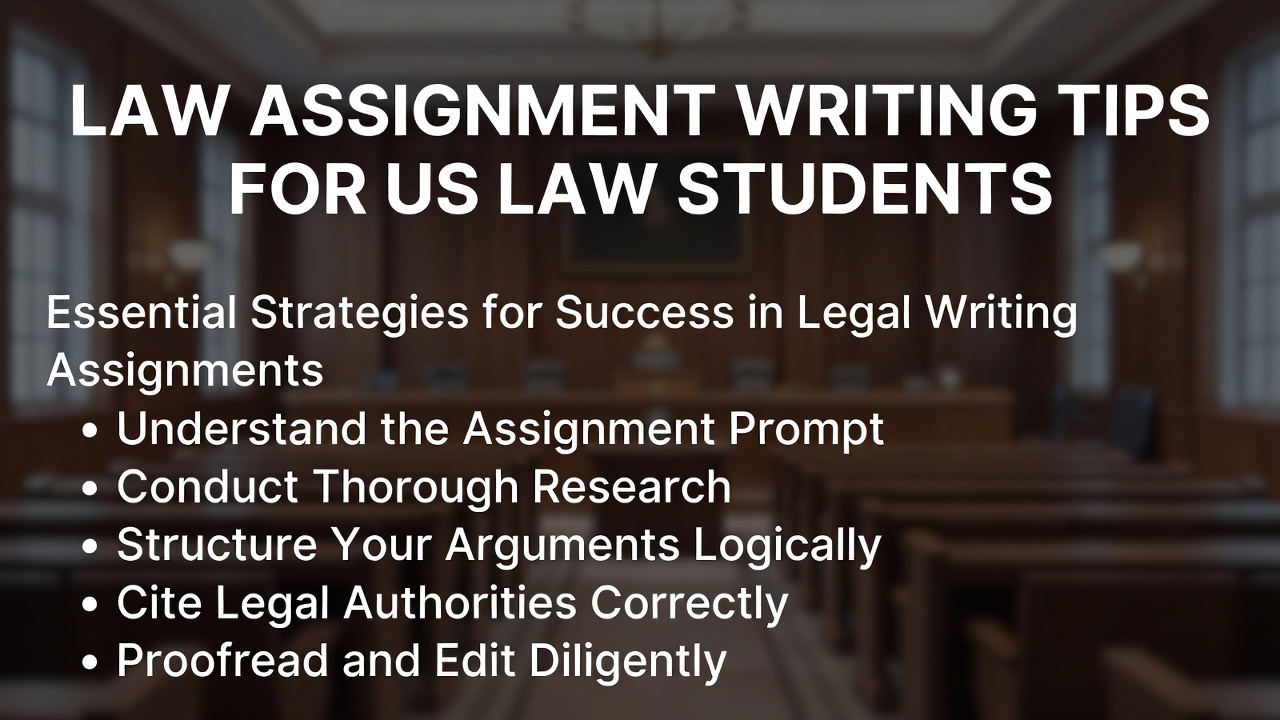
Why law assignments are different
Legal writing in US law schools is not like undergraduate essay writing. Professors want predictive or persuasive analysis that a supervising attorney or judge could rely on. That means precise issues, accurate rules, careful application to the facts, and no filler. First-year legal research and writing courses often grade memos and briefs closely on structure and citation.
Common challenges
- Spotting every issue in a dense fact pattern.
- Synthesizing a rule from several cases.
- Applying law to facts instead of restating the law.
- Learning Bluebook citation format.
Step 1: Read the prompt carefully
Identify the task: an objective memo predicts an outcome; a brief argues for one side; an exam answer spots and analyzes issues under time pressure. Note the jurisdiction, any closed universe of authorities, page or word limits and the citation rules.
Read the facts twice. On the second pass, mark facts that seem to matter legally: dates, relationships, statements, and anything that looks out of place. Professors rarely include facts without a reason.
Step 2: Do focused legal research
- Start with secondary sources (treatises, practice guides, law review articles) to understand the area.
- Find the controlling statutes and cases for your jurisdiction.
- Use Westlaw or Lexis through your law school, plus free sources such as Cornell’s Legal Information Institute.
- Check that every case is still good law with a citator.
- Keep a research log: sources, search terms and key holdings.
Our guide on researching academic papers covers general search techniques that also help here.
Step 3: Structure with IRAC or CREAC
| Part | Purpose |
|---|---|
| Issue / Conclusion | State the precise legal question, or your answer to it first (CREAC) |
| Rule | The governing law, synthesized from statutes and cases |
| Explanation | How courts have applied the rule (CREAC) |
| Application | Apply the rule to your facts; compare and distinguish cases |
| Conclusion | Your answer, with appropriate confidence |
Use one IRAC or CREAC unit per issue or sub-issue. Many legal writing professors prefer CREAC for memos because it leads with the conclusion.
Step 4: Make the application count
Application is where you show legal reasoning. Weak answers restate the rule and jump to a conclusion. Strong answers use the facts.
- Match specific facts to each element of the rule.
- Compare your facts to precedent: "Like the defendant in Case A, our client..."
- Distinguish unfavorable cases with concrete differences.
- Address counterarguments and explain why they are weaker.
Step 5: Write with precision
- Use active voice and short sentences where possible.
- Use terms of art consistently; do not switch between "contract" and "agreement" for variety.
- Avoid absolute claims unless the law is truly settled.
- Use headings that match the issues.
- Cut throat-clearing phrases like "it is important to note that."
Step 6: Cite correctly
Most US law schools use The Bluebook; some legal writing programs use the ALWD Guide. Key habits:
- Full citation on first reference, short form afterward, and "Id." where appropriate.
- Pinpoint cites to the exact page.
- Correct abbreviations for reporters and courts.
- Italicize or underline case names consistently.
Cornell LII’s free "Introduction to Basic Legal Citation" is a helpful quick reference alongside the official Bluebook.
Step 7: Edit and proofread
Read your memo as the supervising attorney would: could they act on it? For clarity and proofreading support, see our assignment editing service; for related coursework in government and policy, see political science assignment help.
Worked example: a short IRAC answer
Here is a simplified, fictional example to show how the parts fit. Real answers need the actual rule from your jurisdiction and course materials.
- Issue: Did Sam accept Lee's offer to sell a used car when Sam replied, "I'll take it if you include new tires"?
- Rule: Under the common law "mirror image" rule taught in many contracts courses, an acceptance must match the offer's terms. A reply that adds new terms is usually treated as a counteroffer.
- Application: Sam's reply added a new term (new tires) as a condition. It did not match Lee's offer, so it reads as a counteroffer, not an acceptance. Lee never agreed to the new term.
- Conclusion: No contract was formed, because Sam's reply was a counteroffer that Lee did not accept.
Notice that the application does the real work. It ties the specific facts ("new tires," "if") to each part of the rule. Also note that for sales of goods, the UCC may apply different rules, which a strong answer would flag.
Memo, brief or exam answer: what changes
| Format | Audience | Tone and goal |
|---|---|---|
| Office memo | A supervising attorney | Objective; predicts the likely outcome, including weak points |
| Brief | A court | Persuasive; argues for your client within the law |
| Exam answer | Your professor | Spot every issue, apply rules fast, and reach conclusions |
Using a persuasive tone in a memo, or hedging every point in a brief, is a common first-year slip. Check which one the assignment asks for before you write a word.
Legal writing editing checklist
- Each section opens with a clear conclusion or thesis sentence.
- Rules are stated before they are applied, with citations.
- Every key fact you rely on appears in the analysis, not only in the facts section.
- Counterarguments are addressed, not ignored.
- Terms of art are used the same way every time.
- Citations follow the Bluebook or your school's required guide.
- Passive voice is used only when it helps.
If you want feedback on clarity and flow, our assignment editing service can review language and structure. Always follow your school's honor code on outside help for graded legal writing.
Build strong habits early
Legal writing improves with feedback. Read every comment on your memos, keep a list of recurring issues, and visit your legal writing professor or teaching assistant. Habits formed in your first year carry into summer jobs, clerkships and practice. If you need broader assignment support, our assignment writing service explains the options.