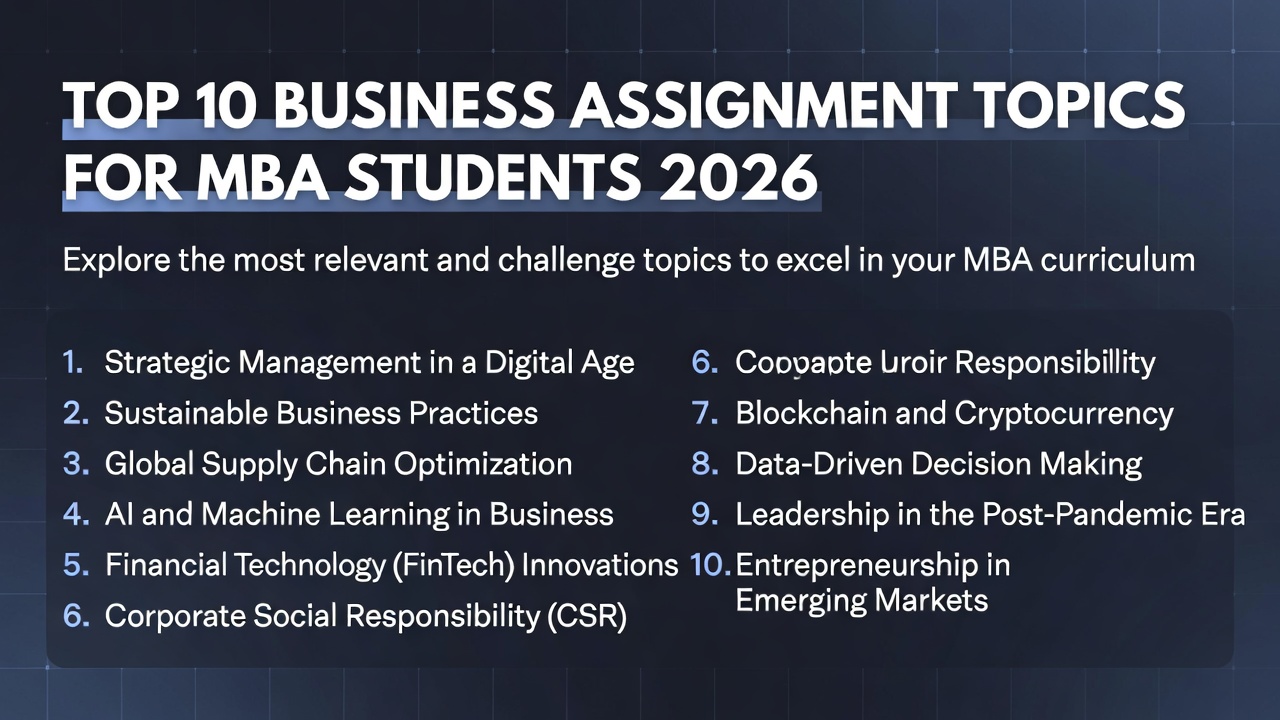
Top 10 Business Assignment Topics for MBA Students (2026)
Strong MBA assignment topics for 2026 include AI adoption, supply chain resilience, ESG reporting, hybrid work, pricing under inflation, fintech lending, data privacy in marketing, startup funding, DEI strategy and healthcare business models. Pick one that fits your course, narrow it to a specific company or industry, and frame it as a decision question.
Key takeaways
- Choose topics tied to a real business decision.
- Narrow to one company, industry or region.
- Use frameworks your course teaches (SWOT, Porter, NPV).
- Back claims with filings, data and peer-reviewed sources.
What makes a good MBA topic
MBA instructors usually want analysis that a manager could act on. A good topic is current, has data available, connects to your course frameworks, and is narrow enough to analyze in depth within the word limit.
The 10 topics at a glance
| Topic | Best-fit courses |
|---|---|
| 1. AI adoption and workforce strategy | Strategy, HR, operations |
| 2. Supply chain resilience after reshoring | Operations, strategy |
| 3. ESG reporting and investor decisions | Finance, accounting |
| 4. Remote and hybrid work productivity | Organizational behavior, HR |
| 5. Pricing strategy under inflation | Marketing, economics |
| 6. Fintech and small business lending | Finance |
| 7. Customer data, privacy and personalization | Marketing, legal |
| 8. Startup funding in a higher-rate environment | Entrepreneurship, finance |
| 9. Diversity, equity and inclusion strategy | Leadership, HR |
| 10. Healthcare business models | Strategy, healthcare management |
Topics with sample questions
1. AI adoption and workforce strategy
Sample question: How should mid-size US firms decide where generative AI replaces, augments or leaves tasks unchanged?
Good for: Strategy, HR, operations courses. Use company filings, industry reports and peer-reviewed research, and pick one company or industry to keep the scope manageable.
2. Supply chain resilience after reshoring
Sample question: Nearshoring to Mexico versus domestic reshoring: cost, risk and lead-time tradeoffs for a US manufacturer.
Good for: Operations, strategy courses. Use company filings, industry reports and peer-reviewed research, and pick one company or industry to keep the scope manageable.
3. ESG reporting and investor decisions
Sample question: How do climate-related disclosure requirements affect capital allocation and reporting costs?
Good for: Finance, accounting courses. Use company filings, industry reports and peer-reviewed research, and pick one company or industry to keep the scope manageable.
4. Remote and hybrid work productivity
Sample question: Which hybrid policies retain talent without hurting collaboration? Compare company case studies.
Good for: Organizational behavior, HR courses. Use company filings, industry reports and peer-reviewed research, and pick one company or industry to keep the scope manageable.
5. Pricing strategy under inflation
Sample question: How have consumer brands used shrinkflation, tiering and promotions, and what did it do to loyalty?
Good for: Marketing, economics courses. Use company filings, industry reports and peer-reviewed research, and pick one company or industry to keep the scope manageable.
6. Fintech and small business lending
Sample question: Do online lenders close the credit gap for small businesses, and at what risk?
Good for: Finance courses. Use company filings, industry reports and peer-reviewed research, and pick one company or industry to keep the scope manageable.
7. Customer data, privacy and personalization
Sample question: How do state privacy laws change digital marketing strategy?
Good for: Marketing, legal courses. Use company filings, industry reports and peer-reviewed research, and pick one company or industry to keep the scope manageable.
8. Startup funding in a higher-rate environment
Sample question: How have venture funding terms and startup strategy changed as interest rates rose?
Good for: Entrepreneurship, finance courses. Use company filings, industry reports and peer-reviewed research, and pick one company or industry to keep the scope manageable.
9. Diversity, equity and inclusion strategy
Sample question: How are companies adapting DEI programs amid legal and political changes, and what outcomes can be measured?
Good for: Leadership, HR courses. Use company filings, industry reports and peer-reviewed research, and pick one company or industry to keep the scope manageable.
10. Healthcare business models
Sample question: Telehealth, retail clinics and value-based care: which models are sustainable?
Good for: Strategy, healthcare management courses. Use company filings, industry reports and peer-reviewed research, and pick one company or industry to keep the scope manageable.
How to narrow your topic
- Pick a company or industry you can find data on.
- Turn the topic into a decision: "Should X do Y?"
- Choose the frameworks you will apply.
- Check your sources before committing.
Where to find good sources
- Company annual reports and 10-K filings.
- Your library’s business databases.
- Google Scholar for peer-reviewed research.
- Government and industry data.
See our guide on researching academic papers for search tips and source evaluation.
Structuring your assignment
A typical outline: executive summary, background, analysis using frameworks, options, recommendation, implementation and risks, references. Keep the recommendation specific and supported by your analysis.
For subject support, see business assignment help, marketing assignment help and finance assignment help.
Worked example: narrowing one topic
Here is how a broad idea becomes an assignment you can actually finish in a few weeks.
- Broad: "AI in business."
- Industry: "AI in retail."
- Function: "AI for demand forecasting in grocery retail."
- Angle: "What a mid-sized US grocery chain should weigh before adopting AI demand forecasting."
- Research question: "What are the main costs, risks and expected benefits of AI-based demand forecasting for a mid-sized US grocery chain, based on published cases and industry reports?"
The final version names an industry, a company size, a country and a decision. That gives you a clear scope and a natural structure: costs, risks, benefits, recommendation.
Matching frameworks to topics
| Topic type | Useful frameworks |
|---|---|
| Strategy and competition | Porter's Five Forces, SWOT, VRIO |
| Market entry and expansion | PESTEL, Ansoff Matrix |
| Marketing | STP (segmentation, targeting, positioning), 4Ps or 7Ps |
| Finance and investment | Ratio analysis, NPV and IRR, sensitivity analysis |
| Operations | Value chain analysis, process mapping |
| Organizational change | Kotter's 8 steps, stakeholder mapping |
Pick one or two frameworks and apply them deeply. Listing five frameworks with a sentence each usually reads as shallow. For help with specific areas, see our marketing and finance assignment pages.
MBA assignment checklist
- The topic is narrow enough to cover well within the word limit.
- The research question is stated clearly in the introduction.
- Data comes from credible sources, such as company filings, industry reports and peer-reviewed journals.
- Frameworks are applied to the evidence, not just described.
- Recommendations follow from the analysis and include practical next steps.
- Limitations and assumptions are stated honestly.
- Citations follow the required style, often APA in US business schools.
- An executive summary is included if the format calls for it.
Frequently asked questions
How do I choose an MBA assignment topic?
Pick a current issue that fits your course, has accessible data, and can be framed as a business decision.
How narrow should my topic be?
Narrow enough to analyze one company, industry or decision in depth within your word limit.
Which frameworks work for MBA assignments?
Common choices include SWOT, PESTEL, Porter’s Five Forces, the value chain and NPV or DCF analysis, depending on the course.
Where can I find company data?
Annual reports, SEC filings, your library’s business databases and reputable industry reports.
Can I write about a company I work for?
Often yes, and it can give you useful insight. Check your program’s rules, avoid sharing confidential information, and get permission if you use internal data.
How many sources does an MBA assignment need?
It depends on the length and the instructor. Focus on quality: a mix of company data, industry reports and academic research usually works better than a long list of weak sources.
Picked a topic but stuck on the analysis?
Share your brief, and we will help you plan the structure.
Get MBA assignment help